
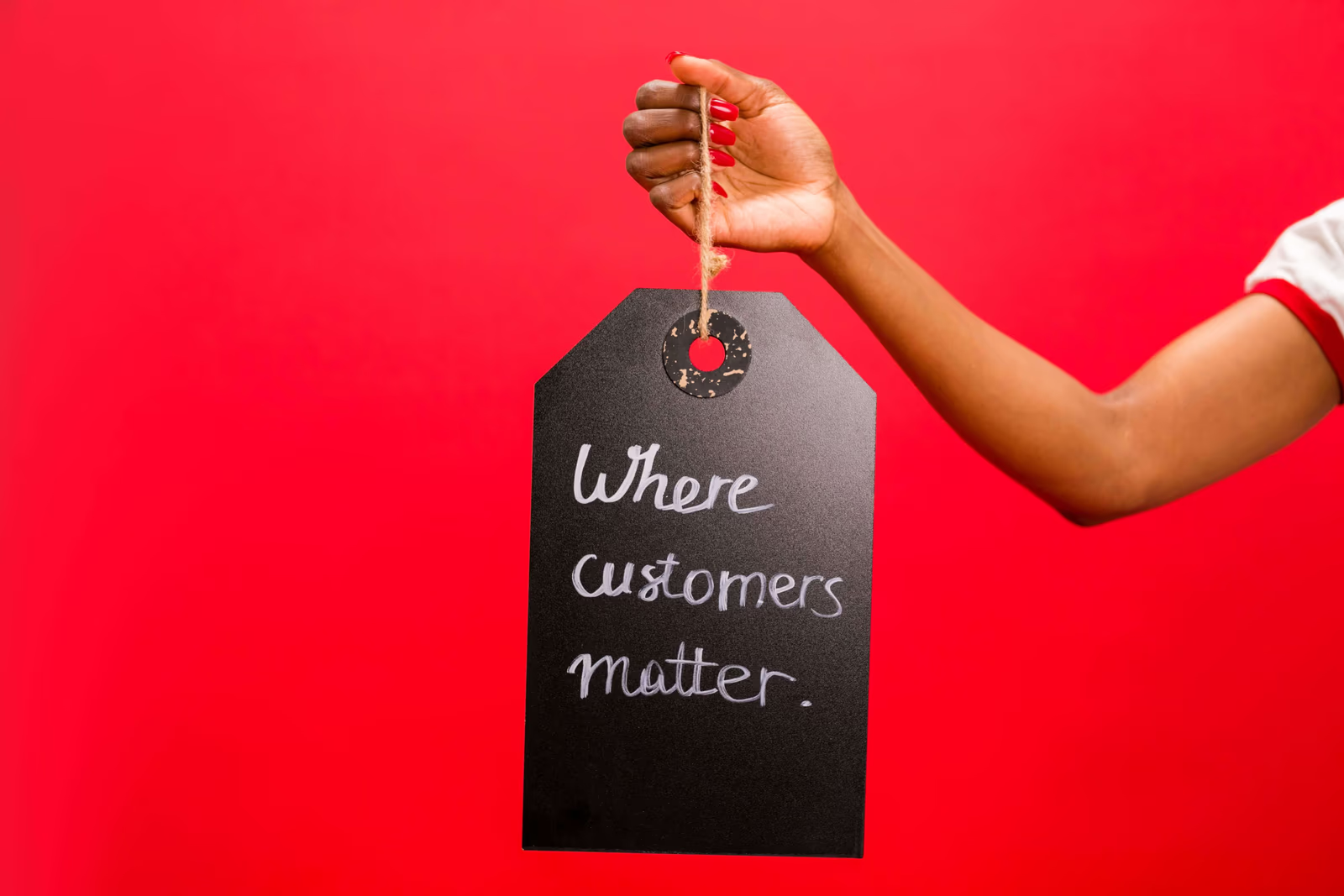
Most businesses pour their energy into winning new customers and comparatively little into keeping the ones they have, which is almost exactly backwards. Winning a customer is expensive and getting more so; keeping one is far cheaper, and a loyal customer is worth many times a one-time buyer, because they return, spend more over time, and bring others with them. For a local business especially, loyalty and genuine community are not soft extras but the foundation of a durable business, often the difference between one that has to constantly chase new custom to stand still and one that grows on the strength of the relationships it has built. This guide covers how to build customer loyalty and real community, why they matter, and why they deserve far more attention than they usually get.
Why loyalty matters more than most businesses realize
The case for loyalty is partly a matter of economics that many businesses never actually work through.
Keeping a customer costs far less than winning one. Acquiring a new customer, through marketing, advertising, and the effort of earning trust from scratch, is expensive, while keeping an existing happy customer costs a fraction of that. A business focused entirely on acquisition is repeatedly paying the high cost of winning people it then fails to keep.
Loyal customers are worth much more over time. A customer who returns again and again, over years, is worth vastly more than a single transaction, and that lifetime value is where much of a business's real profit lives. A business that thinks only in terms of individual sales misses most of the value its customers actually represent.
Loyal customers bring others. People recommend businesses they are loyal to, and word of mouth from a genuinely loyal customer is among the most powerful and least expensive forms of growth there is. Loyalty does not just retain value; it generates new custom at almost no cost.
Loyalty is a competitive moat. Customers who are genuinely loyal to a business are customers competitors cannot easily take, which makes loyalty one of the more durable advantages a business can build in a competitive market.
For a local business in particular, where the pool of potential customers is finite and word of mouth travels fast, these effects are magnified. A local business simply cannot grow indefinitely by acquisition alone, which makes loyalty and community not optional but central.
The finiteness of a local market is worth dwelling on, because it changes the maths entirely. A national or online business can, in principle, keep growing by reaching ever more new people, so a leaky bucket of customers can be masked by pouring in more. A local business cannot: it is serving a bounded community, so every customer it loses is one it will likely have to win back or replace from a limited pool, and the same people encounter its reputation repeatedly. In that setting, keeping customers and being genuinely well regarded is not one strategy among many but close to the whole game, because there is no endless supply of newcomers to make retention optional.
Loyalty and community are not the same thing
It is worth distinguishing two related ideas, because they reinforce each other but are not identical. Loyalty is a relationship between a business and an individual customer: the customer keeps choosing the business, trusts it, and feels a connection to it. Community is broader: a sense among customers of belonging to something around the business, of being part of a group the business is at the centre of, which can connect customers to one another and not only to the business.
Both matter, and the strongest businesses build both. Loyalty keeps individual customers returning; community creates a belonging that deepens that loyalty and spreads it, turning customers into something more like members or advocates. A local business that becomes a genuine part of its community, and whose customers feel they belong to something around it, has built something far more durable than a business that merely completes transactions well, however good those transactions are.
What actually builds loyalty
Knowing how to build customer loyalty starts from recognizing that it is earned, mostly through things simpler and more genuine than formal schemes.
A genuinely good experience, consistently. The foundation of loyalty is simply being good to deal with, reliably. Customers return to businesses that consistently serve them well and treat them right, and no loyalty tactic compensates for an experience that does not deserve loyalty. This is the ground everything else builds on.
Being known and valued. People are loyal to businesses where they feel recognized and valued as people rather than processed as transactions. For a local business, this personal recognition is a genuine advantage over larger, more impersonal competitors, and much of what earns real loyalty.
Genuine care. Customers can tell the difference between a business that genuinely cares about them and one performing care to extract more money, and they become loyal to the former. Real care, consistently shown, is one of the most powerful loyalty builders there is, and one that cannot be faked for long.
Staying connected. Loyalty fades when a business is out of sight, so staying in genuine, welcome contact with customers, being present and useful rather than merely promotional, keeps the relationship alive between visits.
Recognizing and rewarding loyalty. Acknowledging and valuing customers who return, whether formally or simply by treating regulars as valued, reinforces loyalty by making loyal customers feel their loyalty is seen and appreciated.
The through-line is that loyalty is built on genuine relationship and genuine care far more than on tactics, which is why businesses that try to buy loyalty through schemes alone, without the underlying experience and care, usually find it does not work.
Building genuine community
Community goes a step beyond individual loyalty, and for a local business it can be a powerful thing to build. A business that becomes a genuine part of its local community, involved in it, present in it, contributing to it, earns a place in people's lives that a purely transactional business never does. This can mean genuine involvement in local life, being a business the community feels is one of its own, and creating ways for customers to feel part of something around the business.
The key is that community has to be genuine to work. People can tell the difference between a business genuinely involved in and contributing to its community and one performing community involvement for marketing, and only the genuine version builds the belonging that matters. A business that authentically cares about and contributes to its community, and gives its customers a sense of belonging to something around it, builds a loyalty and advocacy that is extraordinarily durable, because people do not abandon something they feel part of. Genuine community is harder to build than a loyalty scheme, and worth far more.
There is also a quieter benefit worth naming. A business embedded in genuine community becomes resilient in a way a purely transactional one is not. When a community feels a business is one of its own, it tends to support it through difficulty, forgive the occasional misstep, and choose it even when a cheaper or more convenient option appears, because the relationship is not purely commercial. That resilience, the goodwill of people who genuinely value a business and feel connected to it, is one of the most valuable and least measurable assets a local business can have, and it is available only to those who build community for real rather than as a marketing exercise.
Where loyalty and community live, and the website
Loyalty and community are built mostly through genuine relationship, but a business's website and digital presence play a real supporting role. The website is often how a business stays connected to its customers between visits, how it shares what it is doing, how customers engage with it, and how the sense of a business and its community is expressed and sustained online. A business that uses its website and digital presence to stay genuinely present and useful to its customers, rather than only to acquire new ones, supports the loyalty and community that sustain it.
This is a shift in how many businesses think about their site. A website built purely as a tool for acquiring new customers misses much of its value; one that also serves to nurture existing relationships, keep customers connected, and sustain a sense of community does far more for the business over time. The site is not only a way to win customers but a way to keep them, and for a business that understands loyalty's value, that keeping is where much of the return lives.
There is a specific opportunity here that many local businesses overlook: staying in genuine, welcome contact with existing customers between visits. A customer who has a good experience and then never hears from a business again gradually drifts, not from dissatisfaction but from simply forgetting, while a business that stays gently present, useful, and worth hearing from remains top of mind when the customer next has a need. Done well, this is not bombarding people with promotions, which erodes goodwill, but being genuinely worth staying connected to, which is a very different thing. A business's website and the ways it stays in touch, handled with that restraint, are much of how a good first experience becomes an ongoing relationship rather than a single transaction that fades.
What good loyalty and community look like
A business that has built genuine loyalty and community has customers who return again and again, feel genuinely valued and connected, recommend it readily, and in many cases feel part of something around it. It has escaped the treadmill of constant acquisition, growing instead on the strength of relationships and word of mouth, with a base of loyal customers that competitors cannot easily take. It does not treat customers as transactions, perform care it does not feel, or focus so entirely on winning new customers that it neglects the ones it has. It is genuinely good to its customers, genuinely part of its community, and rewarded with the durable loyalty that follows.
None of this is quick, and that is much of why it is valuable. Loyalty and community are built slowly, through consistency over time, which means they cannot be bought in a hurry or copied overnight by a competitor. A business that commits to genuinely serving and valuing its customers, year after year, accumulates something that compounds and endures, while one chasing quick wins never builds it. The slowness is not a drawback but the very thing that makes what is built defensible, because anything that could be assembled quickly could be taken quickly too.
Questions local businesses often ask
Do we need a formal loyalty programme? Not necessarily. Formal programmes can help, but loyalty is built far more by a genuinely good experience, real care, and personal recognition than by any scheme, and a programme layered over a poor experience does little. Get the genuine relationship right first; a formal programme is an optional reinforcement, not a substitute.
Isn't focusing on existing customers giving up on growth? The opposite. Loyal customers bring new ones through word of mouth, which is often a business's most effective growth, and retaining customers you have already won is far cheaper than constantly replacing ones you lose. Loyalty is a growth strategy, not an alternative to one.
How do we build community as a small local business? Genuinely, by being a real part of your local community and giving customers a sense of belonging to something around your business, rather than by performing involvement for marketing. Authenticity is everything; people can tell the difference, and only the genuine version earns the belonging that matters.
What matters most for loyalty? A consistently good experience and genuine care, above all. Customers return to businesses that serve them well and treat them as valued people, and no tactic substitutes for deserving loyalty in the first place.
Where to go from here
Loyalty and community are where a local business's durable value is built, and they deserve far more attention than acquisition alone. To go further, see how we approach web design and SEO, and read into how this looks in specific fields: building community around a local pharmacy, community engagement for dental practices, community for insurance advisors, and loyalty programs for fashion and beauty brands.
Is your business built to keep and deepen its relationships with the customers it has already won, or is it stuck on a treadmill of constantly acquiring new ones to replace the loyalty it never quite built?